

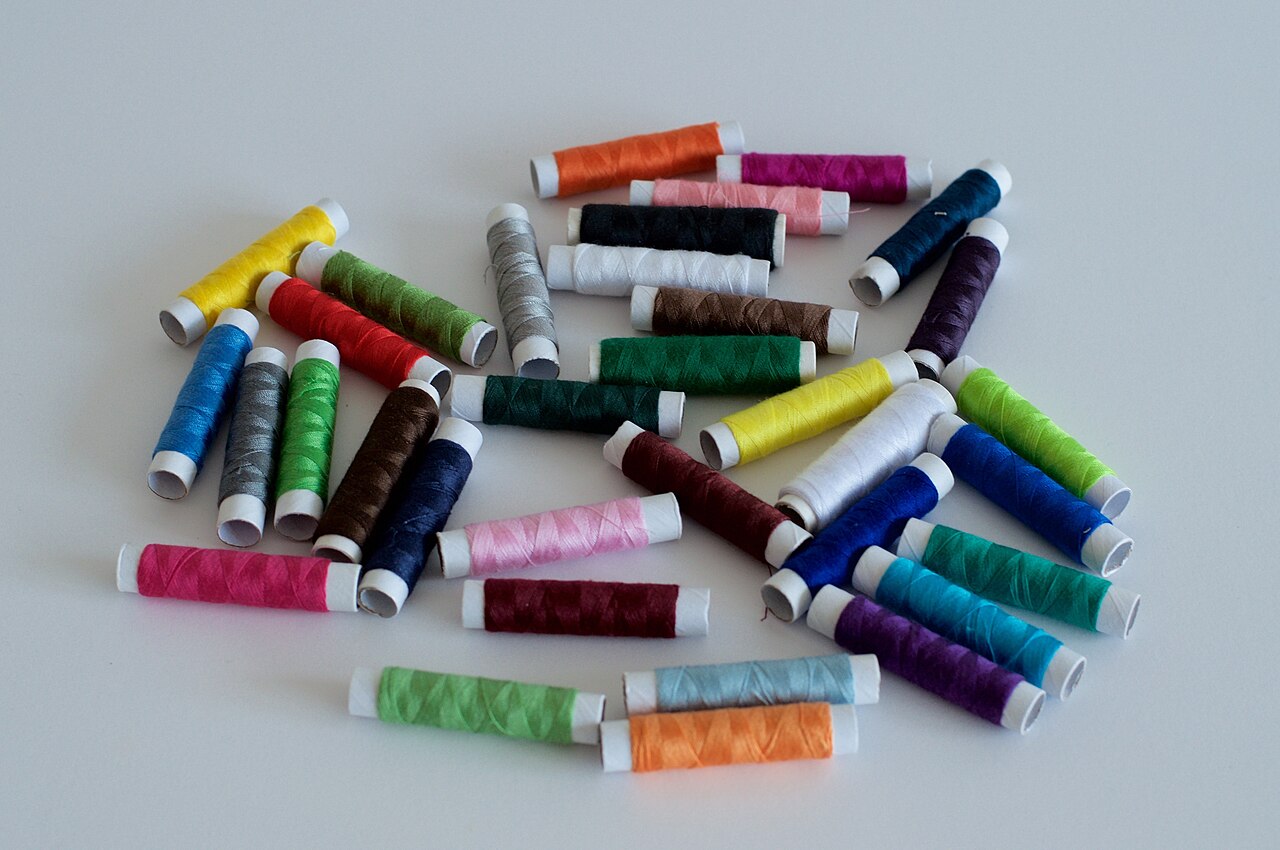
Construction thread is supposed to disappear. Topstitch thread is supposed to declare itself. Most misery at the machine is a construction thread that was matched to the highlight on the spool instead of the shadow in the weave.
Match the shadow, not the highlight
Stonemountain’s matching method: compare a single strand to the cloth, not the wound spool. The wound spool is a cylinder of highlight. A strand lies in the fabric the way a stitch will. When the match is imperfect, it usually is because dye houses are not married. They take the thread a hair darker than the cloth. Darker falls into the seam’s shadow. Lighter sits on top of the weave and sparkles.
Value before hueValue is light versus dark. Hue is red versus blue. A navy thread on black cloth disappears better than a bright black that is actually a cool charcoal sitting too light. Threads Magazine’s construction advice: match value first. Mid greys for cool colors, mid beiges for warm, black/brown/navy on darks, white or pearl grey on pastels.
You do not have to match at all. Threads Magazine’s 2020 piece is explicit: seaming stitches are hidden; a small range of neutrals covers most construction. Grey for cool, beige for warm. On a serger, match only the needle thread (or the left needle on four-thread) and run neutrals in the loopers. That is a cost decision as much as a color one.
How to pull a thread and fan it on the cloth
Aurifil’s matching note is the same motion, written for quilters and just as true on apparel:
- Do not judge from the spool or the label chip.
- Pull a length off. Six to eight inches is enough.
- Lay it on the face of the cloth. Then fan it, several passes side by side, so you see a small field of thread, not a hair.
- Squint. The right thread dissolves. The wrong one remains a drawing.
- Flip the cloth, check the wrong side if the seam will show in a flash lining or an unlined shirt.
A fan of thread on a textured weave will look darker than the same fan on a hard-finished shirting. That is the cloth eating light, not the dye shifting. Believe the fan.
Undertone
Undertone is the warm or cool sitting under a color. A beige can lean yellow or pink or green. A grey can lean blue or brown. If the thread’s undertone fights the cloth, you get a match that “feels wrong” even when the value is close. Warm cloth, warm thread. Cool cloth, cool thread. When you cannot name the undertone, put the candidate threads on the cloth and walk away ten feet. The mismatch is the one you can still see.
Metamerism: fluorescent, daylight, LED
X-Rite: metamerism is two colors that match under one light and split under another. It is common in near-neutrals and in anything assembled from different dye lots, thread and cloth are exactly that. Fluorescent optical brighteners, used to make whites look white, are a regular trigger.
A shop fluorescent can make a warm beige look identical to a cool grey. Daylight at the door will divorce them. Evening LED, depending on its color temperature, will pick a side. The industrial habit is to check a match under more than one source (daylight, store fluorescent, home incandescent or warm LED). You can do a cheap version of that: match at the window, then under the shop lights, then under the lamp you sew by.
Worked example: a “black” shirt
The shirting is a warm black. Brown shows in it, visible at the cut edge. A cool jet thread looks blue-grey on the face in daylight and fine under the fluorescent. A warm black or a very dark brown strand disappears in both. Fan both on the cloth at the window. Keep the one that dies.
Prints versus solids
Stonemountain’s rule for prints: match the ground, the background, not the loudest flower. On a charcoal floral with rust and gold, the charcoal thread vanishes; the rust thread becomes a running commentary in every seam. If several grounds compete, unwind a strand of each candidate and see which one actually hides. They show a four-color cloth where dark blue, not the olive or the red, was the disappearing act.
Threads Magazine on construction: prints hide neutral thread even more easily than solids. That is permission to stop buying a new spool for every floral.
Prints on the body are a different question. Threads’ print-selection extra is about whether a print agrees with a person’s own value and undertone, a garment that repeats the wearer rather than shouting over them. That is wardrobe, not thread. It still uses the same words: value, warmth, repetition.
Topstitch contrast is a choice
Construction match is a disappearing trick. Topstitch is a drawing. Pick it on purpose.
- Tone-on-tone topstitch (a little darker than the cloth) is the quiet garment: jeans in a matching gold-brown, a shirt-collar stay that you feel more than see.
- Contrast topstitch is a design line: light on denim, dark on canvas, a second color on a sport stripe. It will show every wobble in your stitch length, so test.
- A construction thread that accidentally contrasts is not topstitch. It is a mistake you will see at every seam inside a flash of the hem.
If you want contrast, change the thread for those rows and go back to the matching spool for the rest. Do not split the difference with a half-match that is neither hidden nor drawn. Weight still matters: a 40 wt quilting line will read louder than all-purpose of the same hue. all-purpose vs quilting thread.
Bobbin and needle colors
For hidden seams, needle and bobbin can be the same. For a hem that shows on both sides of a scarf or a reversible cloth, you may thread the needle to one face and the bobbin to the other. Test: a tension imbalance will pull the wrong color to the face. For topstitch, a matching bobbin on the wrong side keeps the inside from looking like a different garment.
Lighting when you sew is part of matching. Aurifil: blue or yellow room light shifts both thread and cloth. If you matched at a window and sew under a warm bulb, you may not notice a drift until morning. That is metamerism under mixed lamps, not a bad spool.