

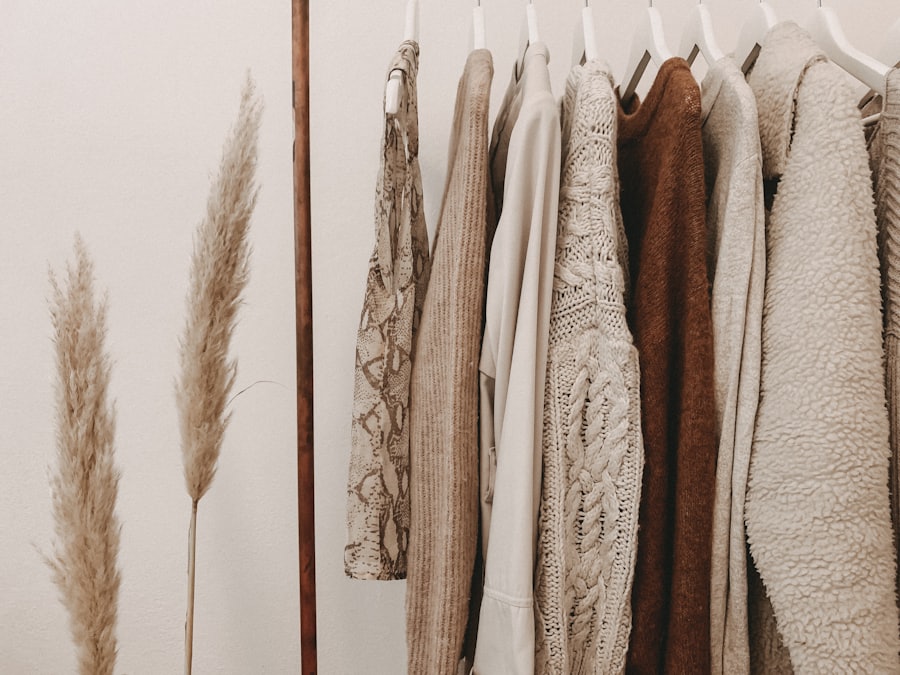
A bolt is a small engineering object. The fiber tells you how it lives in water and heat. Woven, knit, or neither: that structure tells you how it will move under a needle. Weight and drape tell you whether a shirt will hang or a jacket will stand. Grain and selvage tell you which way is true. Miss one of those and the garment argues with the body.
Fiber
Fiber is the raw stuff spun into yarn. Cotton, linen, wool, and silk are natural. Rayon (viscose) is a manufactured cellulosic: plant pulp, chemically regenerated. Polyester is a synthetic. Blends mix two or more so you get some of each behavior, and some of each vice. Mood Fabrics frames the first shopping question as: know the properties of the cloth before you cut, so wash, wear, and drape are choices instead of surprises.
DefinitionFiber is the raw material. Yarn is fiber twisted into a strand. Cloth is yarn woven, knitted, or otherwise locked. Thread is the strand you sew with, not the strand the cloth is made of.
| Fiber | What it does | What it costs you |
|---|---|---|
| Cotton | Breathable, takes a crease, washes, beginner-friendly. | Wrinkles. Can shrink hard if it was not relaxed on the bolt. |
| Linen | Cool, strong when dry, honest hand, ages with wash. | High shrinkage and wrinkle. Pre-wash like you mean it. |
| Wool | Springs back, takes steam, insulates when damp. | Relaxation shrinkage. Some pieces are labeled sponged or needle-ready; many are not. |
| Silk | High luster, strong dry, fine drape in charmeuse and crepe. | Weak when wet. Heat-shy. Many silks are dry-clean only in practice. |
| Rayon / viscose | Drapes, dyes deep, cheap silk-stand-in in challis and crepe. | Stretches, especially on bias. Shrinks and grows. Treat as unstable until proven. |
| Polyester | Strong, colorfast, holds a press less, wears hard. | Low breathability in dense weaves. Heat can glaze it. |
| Blends | Cotton/poly for work shirts; wool/poly for crease; cotton/spandex for give. | You inherit both care labels. The smaller percentage still matters at the iron. |
Elastane (spandex, Lycra) in small doses, two to five percent, is what turns a woven into a stretch woven, or a jersey into a recovery knit. It does not show on the face. It shows when you pull.
Weave versus knit
Most apparel cloth is one of two machines: a loom or a knitting machine. Wovens are a grid. Knits are loops. That split decides pattern, needle, seam, and whether a straight stitch will pop the first time you raise your arms.
WovenWarp yarns run the length of the bolt, parallel to the selvage. Weft yarns run selvage to selvage. The grid has little give on the straight grain, more on the crossgrain, and the most on the true bias.
KnitYarn is looped. The cloth already has mechanical stretch, even without elastane. Jersey (single knit) curls to the knit face at the cut. Interlock and ponte are double knits; they lie flatter and are what people mean, usually, when they say a knit is “stable.”
A pattern written for woven cloth assumes almost no stretch and includes wearing ease so you can sit. A pattern written for knits often includes negative ease: the finished garment is smaller than the body, and the cloth does the rest. Mixing those two without rewriting the pattern is how a “simple tee” becomes a sausage or a sack.
Weight: oz, gsm, and the old shop words
Weight is mass per area. Shops list ounces per square yard or grams per square meter (GSM). Seamwork’s working bands, used as a starting map rather than law:
| Band | Seamwork’s numbers | Shop language |
|---|---|---|
| Lightweight | Up to about 7 oz / 237 GSM | Shirting, lining, blouse-weight, voile, many jerseys |
| Medium | About 7 to 11 oz / 373 to 475 GSM in their examples | Bottomweight-adjacent, mid denim, gabardine, ponte |
| Heavy | More than 11 oz; they also cite 475 GSM | Bottomweight, canvas, coating, heavy denim |
Convert roughly as 1 oz/yd² ≈ 33.9 GSM. Seamwork’s medium band mixes those two systems a little; believe a numbered GSM on the bolt before you believe the adjective “medium.” A 12.9 oz denim at 438 GSM hangs stiff. A 6 oz denim at ~203 GSM folds. Same fiber family, different garment.
Old counter words still earn their keep:
- Shirting: light, often 2 to 6 oz, meant to live next to skin and take a collar.
- Bottomweight: trousers, jackets, bags. Enough mass that a seam will not collapse.
- Lining: light, slick or fine, there to hide construction and let a coat slide on. Not a shell.
Weight is not drape. Organza is light and stiff. Wool crepe can be heavy and fluid. Seamwork’s point: ask both questions, not one.
Drape
Drape is how the cloth hangs and folds. “Body” means it stands away. “Fluid” means it follows. You cannot sew body into chiffon with optimism. You can add interfacing to give a cloth more body; you cannot take body out of organza and make it chiffon.
Worked example: same cotton, different hang
Seamwork compares two 100% cotton flannels of similar weight. One is described as a flexible drape, the other as a light, fluttering drape. The adjectives in the listing are doing real work. If a shop gives you no adjectives and no hanging photo, you are guessing. Guess with a swatch, not a whole dress cut.
Grain, selvage, bias
Lengthwise grain (straight grain, warp) runs parallel to the selvage. It is the stable direction. Crossgrain (weft) runs selvage to selvage and gives a little more. Bias is any diagonal; true bias is 45 degrees to both. Threads Magazine’s Bias 101: garments cut on the bias look softer, stretch more, and appear thinner than the same cloth on the straight grain. They also need more yardage and want to be cut in a single layer so the grain does not walk.
SelvageThe self-finished edge of a woven, where the weft turns. It does not ravel. It is often denser than the field, which is why you usually cut it off a hem, it will hang differently. It is also the reference for grain. Fashion-Incubator: a grainline on a pattern is a notation for how to lay the piece on the goods, not a decoration.
A one-arrow grainline means nap or a one-way print: all pieces face the same way. Two arrows, or a line with none, means you may rotate 180 degrees. No grainline at all is a policy choice, common on some nonwoven interfacings.
Nap and pile
Nap is direction. Run a hand parallel to the selvage. Smooth one way, rough the other. Velvet, velveteen, corduroy, fleece, terry, fake fur: Sewing.org groups these as fabrics that need a with-nap layout. Cut every major piece the same way or you get two colors from one bolt.
Threads on velvet: nap up looks darker and absorbs light; nap down looks lighter and reflects. Typical ready-to-wear velvet is cut nap down because it mats less. Threads on corduroy: nap up looks darker; nap down looks lighter and shinier; skirts and pants often wear better nap down so the seat does not glaze. Pick one and stay with it. Mark an arrow on the wrong side before you unpin the pattern.
What “stable knit” actually means
It does not mean “a knit that will not stretch.” It means a knit whose stretch is modest, whose recovery is decent, and whose cut edge does not roll into a tube while you are still pinning. Ponte, some interlocks, stable double knits, and firm sweater knits sit in this bin. Tissue jersey, slinky, and unbrushed sweater knits do not, even if a listing says “easy.”
A practical test at the counter: pull four inches across the grain and see how much you get, then let go. If it stays stretched, it will bag at the seat and elbow. If it springs back and the cut edge lies reasonably flat, you may treat it as stable enough for a pattern that asked for ponte or double knit. If the envelope said “stable knits only” and you bought rib, the neckband will win.
Garment versus home-dec
Home-dec cloth is often heavier, more stain-finished, and less concerned with drape against a moving body. Upholstery and drapery weights make bags, aprons, and some jackets. They make miserable shirts. Apparel cloth is built to bend at the elbow. If a bolt is filed as decorator, believe the file. Pre-wash still applies if the finished thing will ever see a machine; many home-dec finishes (stain, fire, dry-clean-only) change that answer. Read the end.
How to read a bolt end
The end of the bolt, or the selvedge print on better goods, is the cloth’s paperwork. Look for:
- Fiber content by percentage.
- Width, usually 44/45" or 58/60" in apparel.
- Care: wash, dry-clean, “needle-ready,” “sponged,” Sanforized.
- Country of origin, sometimes woven into the selvage.
- Repeat size on prints, which eats yardage.
Mood’s public FAQ is blunt on color: order a swatch. A screen is a liar. The bolt end will not tell you drape; your hand, or a hanging swatch, will. If content and care are missing, you are buying a mystery and you should pre-wash a snippet before you commit the cut.
In the U.S., a sewn textile’s fiber names are not a store’s poetry. The FTC Textile and Wool Acts require generic fiber names and percentages (5% rule; about 3% tolerance). If the remnant has no tag, use fiber ID at the table. Label, then hand, then a cautious burn. Do not guess that it “feels like cotton.” Sewing.org 4.107 is the worktable sort: animal, vegetable, synthetic.
Pre-wash and grain
South Dakota State Extension’s old fact sheet still holds: decide if the cloth needs shrinking, is on grain, and is free of surface trouble before you cut. UNL on wool: relaxation shrinkage happens because warp was under tension on the loom. Some wools arrive sponged or needle-ready; if unlabeled, test with steam under a press cloth. Cotton and linen that will be washed should be washed and dried the way the garment will live. More shrinkage often happens in the dryer than in the washer.
Straighten the grain before that wash when you can. Clip the selvage and tear, or pull a weft yarn and cut along the puckered line, so the crossgrain end is true. If the folded selvages align and the cut ends do not, the cloth is skewed. Pull on the short corners until the grid squares, or accept that the garment will twist.
Worked example: a first shirt
Envelope says “light to medium wovens: shirting, chambray, linen.” You find a 4.5 oz cotton chambray, 58" wide, 100% cotton, wash cold. That is shirting weight, woven, no nap. Pre-wash warm or cold as you will wear it, tumble if you will tumble the shirt, press on grain, lay the grainline parallel to the selvage. Do not “just use the jersey in the stash because it is also blue.” The pattern’s ease assumes a grid, not a loop.